When people hear the phrase “financial hardship” they often tend to think about the numbers, unpaid bills, debt, rising costs of living or a low income. But reality is that behind every statistic is a person who is trying to navigate impossible decisions, uncertainty and huge amount of stress every single day.
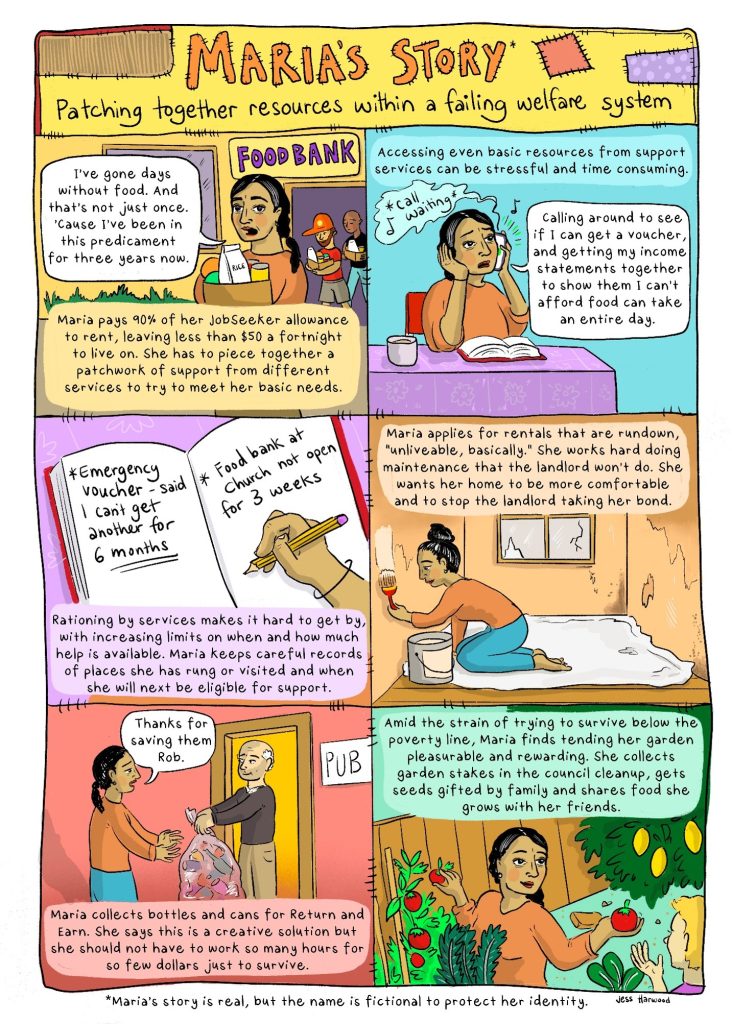
One story that illustrates this is Maria’s story. Despite receiving income support, she spends most of her allowance on rent, leaving a small amount of money to then cover for food, transport and other essentials. Accessing emergency assistance is not straightforward either. Hours are spent calling organisations, gathering paperwork and waiting for support, all while trying to meet basic needs just to survive.
As Maria says: “I’ve gone days without food. And that’s not just once. Cause I’ve been in this predicament for three years now”. Her experience reflects a reality that many people face every single day. And though support services can provide vital assistance, when help is limited, temporary or difficult to access, people can often find themselves patching together multiple sources of support just to simply survive.
For many women experiencing domestic violence, financial hardship is not simply the result of rising living cost. It is often the consequence of leaving a violent relationship and trying to rebuild a life. Financial abuse, disrupted employment, housing instability and ongoing costs of keeping themselves and their children safe can leave women facing impossible decisions long after the violence has ended. As Anne Summer highlights in The Choice: Violence or Poverty (2022), too many women are forced to choose between remaining in a violent relationship or leaving and facing financial insecurity and poverty.
While everyone’s experience of financial hardship is unique, many women escaping domestic violence face additional barriers. Leaving an abusive relationship often means leaving behind a home, possessions, financial security and established support networks. Even after improving their safety, many continue to experience financial stress through limited income, insecure housing and the challenge of rebuilding their lives. Poverty can become another form of control, making recovery even more difficult.
At Immigrant Women’s Speak Out, we see these realities every day, where women who faced domestic or family violence (DFV) and did not have the means to support themselves after leaving an abusive partner, have needed to access our shelter service. All of these women we support are rebuilding their lives after experiencing DFV, while also navigating housing insecurity, financial hardship and the challenge of meeting everyday living costs.
Yet amidst these challenges, stories like Maria’s demonstrate resilience. She finds purpose in tending to a community garden, where she shares food with friends and continues searching for creative ways to get by. These strengths deserve recognition, but resilience should never be mistaken for evidence that the system is working.
No one should have to spend hours proving they deserve food. No one should have to choose between shelter and eating. And no one should have to rely on emergency assistance as a long-term solution.
Raising awareness about financial distress means that we are recognising the human experiences behind the headlines. It means listening to people’s stories without judgement and being able to understand that financial hardship can be experienced by anyone.
By increasing awareness, improving immigration policies and processes, strengthening support services and addressing the underlying causes of financial insecurity, we can work towards a community where everyone has access to the essentials they need. Not just to survive, but to live with dignity and freedom.
Domestic violence and financial hardship are deeply interconnected. Anne Summer’s report found that many women who leave violent relationships experience substantial financial losses, with research showing women’s household income can fall by as much as 45 percent after leaving an abusive partner. Around half of the single mothers in the study relied on government payments as their primary source of income, highlighting how escaping violence often comes at a significant economic cost. These findings demonstrate that safety should never mean being pushed into poverty, yet for many women this remains their lived reality.
Every day, community organisations like ours support women who have made the courageous decision to leave violence, only to find themselves facing another crisis: financial hardship. No one should have to choose between safety and poverty. Supporting women after they leave violence means recognising that financial security is a critical part of recovery, safety and long-term independence.
Everyone has a role to play in creating a community where no one is left to face financial hardships alone. By supporting local community organisations, volunteering, donating where possible, or advocating for stronger social policies, we can help ensure that essential services remain available for those who need them the most. Small actions, when taken together, can make a meaningful difference in building a more compassionate and equitable community.
Reference:
Summers, A. 2022, The Choice: Violence or Poverty: Domestic Violence and its Consequences in Australia Today, University of Technology Sydney, viewed on 7th July 2026. https://www.annesummersresearch.com/the-choice.